Many patients ask this exact question when they already have one or more dental crowns and later lose another tooth nearby. The short answer is yes almost always you can place a dental bridge even if the adjacent teeth already have crowns. In fact, teeth that already have crowns are often the best abutment (support) teeth for a bridge. Below is everything you need to know before making a decision.
Table of Contents
What Is a Dental Crown and How Does It Work?
A dental crown is a custom cap that fully covers a damaged tooth, restoring strength, shape, and appearance after preparation and permanent cementation.
The Purpose of a Dental Crown
A dental crown (sometimes called a “cap”) completely covers a damaged, decayed, root-canal-treated, or fractured tooth to restore its shape, size, strength, and appearance. Crowns are made from porcelain, zirconia, porcelain-fused-to-metal, or gold.
How Crowns Are Placed
The dentist removes a thin layer of enamel (about 1–2 mm), takes an impression or digital scan, and cements the permanent crown weeks later. Once cemented, the crown becomes the new outer surface of the tooth.
Why Existing Crowns Are Actually Ideal for Bridges
Because the tooth is already prepared and covered with a strong material, it usually requires little or no additional preparation to support a bridge. This saves healthy tooth structure and shortens treatment time.
What Is a Dental Bridge and Its Different Types?
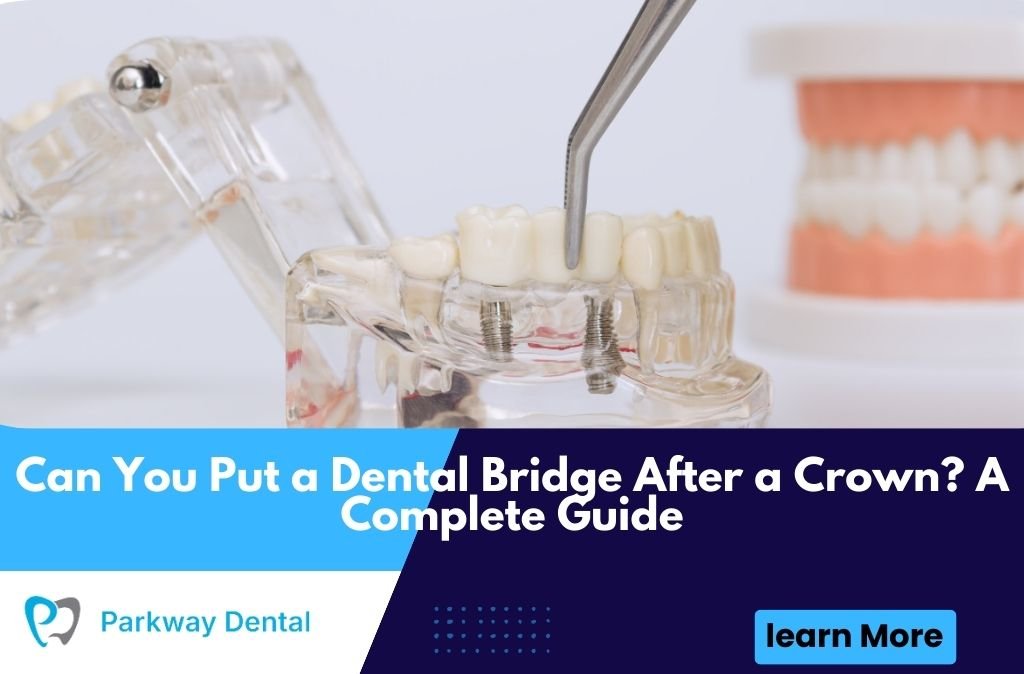
A dental bridge replaces missing teeth using adjacent teeth or implants for support. Types include traditional, Maryland, cantilever, and implant-supported bridges.
Traditional Fixed Bridge
The most common type: two crowns are placed on the healthy (or already crowned) teeth on either side of the gap, and a false tooth (pontic) fills the space in between.
Maryland (Resin-Bonded) Bridge
A conservative option for front teeth that uses metal or zirconia wings bonded to the backs of adjacent teeth. It is rarely used when adjacent teeth already have full crowns.
Implant-Supported Bridge
If both adjacent teeth are missing or unsalvageable, implants are placed and a bridge is attached to the implants instead of natural teeth.
Cantilever Bridge
Used when there is only one suitable abutment tooth next to the gap (less common today because of higher stress on the supporting tooth).
Can a Bridge Be Placed Over Existing Crowns? Detailed Scenarios
Yes. Sound existing crowns often need no prep; older ones may be replaced simultaneously. One crowned abutment or both work perfectly for bridges.
Scenario 1: The Adjacent Teeth Already Have Well-Fitting, Recent Crowns
This is the easiest and most predictable situation. Your dentist evaluates the fit, material, and margins of the existing crowns. If everything is sound, the new bridge is designed so the bridge crowns simply cement directly over the existing ones with little or no adjustment.
Scenario 2: Old or Poorly Fitting Crowns
If the existing crowns are more than 15–20 years old, have open margins, decay underneath, or poor aesthetics, the dentist will usually recommend replacing them at the same time as placing the bridge. You end up with an entirely new, seamless unit.
Scenario 3: Only One Adjacent Tooth Has a Crown
Completely fine. The crowned tooth becomes one abutment, and the natural tooth on the other side is prepared normally for a crown. The bridge joins them together.
Scenario 4: The Missing Tooth Was Previously Supported by a Crown
If you had a crowned tooth that was later extracted, the adjacent teeth (whether crowned or natural) can still support a conventional bridge.
Advantages of Placing a Bridge When Teeth Already Have Crowns
Less tooth removal, stronger support from crown materials, faster treatment, better aesthetics, and usually lower cost than implants or preparing natural teeth.
Less Tooth Reduction Required
Natural teeth need significant shaving to accept bridge crowns. Already-crowned teeth usually need zero or minimal prep, preserving whatever natural tooth remains underneath the old crown.
Stronger Support
Modern zirconia or porcelain-fused-to-metal crowns are extremely strong and distribute biting forces better than many natural teeth.
Faster Treatment Timeline
No need to wait for new crown preparations to heal; the bridge laboratory work can begin immediately after impressions.
Cost-Effective in the Long Run
Replacing one missing tooth with a bridge using existing crowns is almost always less expensive than extracting the abutments and placing two implants.
Potential Challenges and How Dentists Solve Them
Shade mismatch, decay beneath old crowns, or bite issues are common. Solutions: replace crowns together, treat underlying problems, adjust occlusion precisely.
Challenge 1: Different Crown Materials or Shades
Old crowns may not match the color of new bridge porcelain. Solution: Replace all visible crowns at once for uniform aesthetics, or use opaque cement/layers to mask discrepancies.
Challenge 2: Underlying Decay or Fracture
X-rays and clinical exam reveal problems under old crowns. Solution: Remove the old crown, treat the tooth (root canal if needed), and place a new buildup and crown as part of the bridge.
Challenge 3: Bite (Occlusion) Issues
Existing crowns may have worn or improper height. Solution: The new bridge is designed in a dental articulator to create ideal bite relationships.
Step-by-Step Process When You Already Have Crowns
- Comprehensive exam, X-rays, and 3D scans
- Evaluation of existing crowns (age, fit, material, decay risk)
- Treatment planning discussion (bridge vs. implant options)
- Minimal or no preparation of existing crowns
- Digital or traditional impressions
- Temporary bridge while the permanent one is fabricated (2–3 weeks)
- Try-in appointment for fit, shade, and bite
- Final cementation (permanent or semi-permanent depending on future plans)
Bridge vs. Implant: Which Is Better If You Already Have Crowns?
Bridges are faster, cheaper, and ideal when teeth are already crowned. Implants preserve abutments but cost more and take longer to complete.
When a Bridge Is the Clear Winner
- You want the fastest, least invasive solution
- Adjacent teeth already have large fillings or crowns
- Bone levels or medical conditions make implants riskier
- Budget is a significant factor
When an Implant Might Still Be Preferable
- Adjacent teeth are completely virgin/healthy with no restorations
- You are younger and want to preserve natural abutment teeth long-term
- You have a history of clenching/grinding that could overload a bridge
Longevity and Success Rates
Studies show 3-unit bridges on crowned abutments have 85–95% survival at 10–15 years when proper design and oral hygiene are maintained. Implant-supported options reach 95–98%, but traditional bridges remain highly successful, especially when existing crowns provide robust support.
Aftercare for Your New Bridge Over Existing Crowns
- Brush and floss normally; use a bridge threader or interdental brushes under the pontic
- Wear a nightguard if you grind your teeth
- Professional cleanings every 3–6 months
- Avoid extremely hard foods (ice, nuts in shell, bones) directly on the bridge
Conclusion
Yes you absolutely can (and very often should) place a dental bridge after crowns are already present on the supporting teeth. In many cases, existing crowns make the process simpler, faster, less invasive, and more predictable than preparing untouched natural teeth. The decision ultimately comes down to the condition of those crowns, your overall oral health, budget, and long-term goals.
If you’re missing a tooth and the neighboring teeth already have crowns, schedule a consultation today. A skilled Dentist in West Roxbury, MA can examine your specific situation and explain whether a traditional bridge, implant-supported bridge, or another solution will give you the strongest, most aesthetic result that lasts for decades.
Frequently Asked Questions (FAQs)
Will I need to remove my existing crowns to get a bridge?
A: Not always. If the crowns are in excellent condition, the new bridge crowns can cement directly over them with little or no modification.
Is it painful to place a bridge over existing crowns?
A: Usually less painful than preparing natural teeth, because little or no tooth structure is removed. Local anesthesia is still used for comfort.
How much does a bridge cost when teeth already have crowns?
A: Typically $3,000–$6,000 for a 3-unit bridge in most areas (2025 pricing), often less than two individual implants plus crowns.
Can a bridge fail because of old crowns underneath?
A: Rare if the underlying crowns and teeth are healthy. Decay or fracture under an old crown is the main risk, which is why thorough examination and X-rays are essential.
How long does the entire process take?
A: 3–6 weeks from start to finish when minimal preparation is needed — significantly faster than implant treatment.
What if I want to switch to implants later?
A: Many dentists cement the bridge with temporary cement initially so it can be removed without damage if you decide on implants in the future.
Does dental insurance cover bridges over existing crowns?
A: Most plans cover 50–80% of the bridge portion (after deductible), though pre-existing crowns are not billed again.