Dental fillings are one of the most common restorative procedures in dentistry, designed to repair teeth damaged by decay and restore their function and integrity. While fillings are durable and can last many years, they are not permanent solutions. Eventually, most fillings will need to be replaced due to wear, damage, or recurrent decay.
This reality leads many patients to wonder about the longevity of their dental restorations and ask: how many times can a filling actually be replaced? The short answer is that most teeth can support 2 to 4 filling replacements over a lifetime before the remaining tooth structure becomes too compromised for another filling. At that point, a crown, inlay, or onlay typically becomes the appropriate next step. The specific number depends on the original cavity size, tooth location, filling material, and how well the tooth is maintained.
This guide explains why that limit exists, what happens to your tooth with each successive replacement, why fillings sometimes cause pain or infection after placement, how to care for fillings to make them last, and what to expect when a filling can no longer be replaced.
If you have a filling that feels painful, loose, or unusual, Parkway Dental in West Roxbury offers same-day appointments to evaluate and address filling concerns before they escalate.
Table of Contents
Understanding Why Fillings Need Replacement
Before addressing how many times fillings can be replaced, it is important to understand why they eventually fail and require replacement.
Dental fillings can fail for numerous reasons even when properly placed and well maintained. Normal wear and tear from years of chewing gradually breaks down filling material. Fillings can crack, chip, or fracture from biting on hard foods, teeth grinding, or the accumulated stress of constant use. The seal between the filling and tooth structure can deteriorate, creating gaps where bacteria enter and cause new decay around or underneath the filling. This is called recurrent or secondary decay and is one of the most common reasons fillings need replacement.
Older amalgam fillings can expand and contract with temperature changes, eventually weakening the tooth structure around them. Poor oral hygiene that allows new cavities to develop adjacent to existing fillings, changes in tooth structure from additional decay or trauma, and simple aging of materials that have exceeded their expected lifespan all contribute to filling failure.
Signs a filling needs evaluation include sensitivity to hot, cold, or sweet stimuli that signals the seal may have failed, pain when biting down that suggests a cracked filling or recurrent decay underneath, visible chips or cracks in the filling, a rough or uneven surface when you run your tongue over it, and food consistently getting caught around a filled tooth. Schedule a dental appointment promptly when you notice these signs rather than waiting for your regular checkup. Early intervention allows for simpler, more conservative treatment.
How Many Times Can a Filling Be Replaced? The Real Limit
While there is no single universal number, there is a well-understood practical limit based on tooth anatomy.
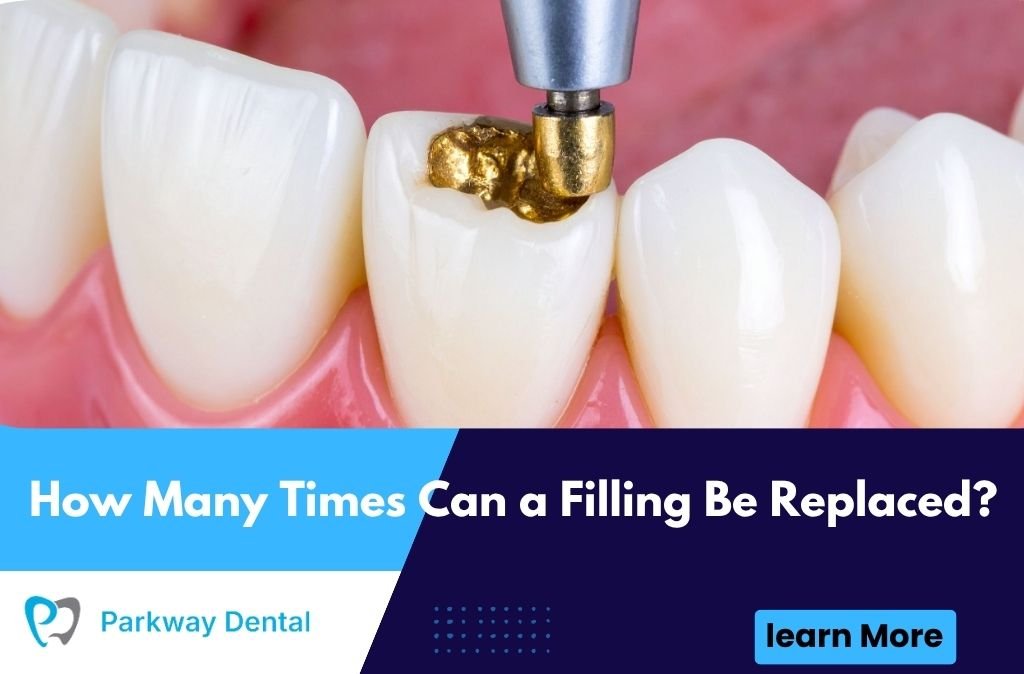
Every time a filling is replaced, additional tooth structure must be removed. Your dentist must remove the old filling material completely, clean out any new decay, and often remove a thin layer of surrounding tooth structure to create clean margins for the new restoration. With each successive replacement, the tooth becomes progressively smaller and weaker.
After multiple replacement cycles, you reach a point where insufficient tooth structure remains to support another filling. The tooth walls may become too thin, the overall structure too compromised, or the cavity too large for a filling to be stable or predictable.
For most patients, a tooth can sustain 2 to 4 filling replacements over a lifetime before more extensive treatment becomes necessary. Some small, well-maintained fillings on front teeth may allow for more replacements because more healthy structure remains. Large fillings on heavily stressed molars may require a crown after just one or two replacements.
How many times a composite filling can be replaced specifically follows the same principle. Because composite resin bonds chemically to tooth structure and typically requires less removal of surrounding tooth during replacement, some dentists can replace composite fillings slightly more conservatively than older amalgam restorations, potentially adding one additional replacement cycle in some cases.
Factors that affect how many replacements are possible:
The size of the original cavity: small fillings allow more replacement cycles than large ones. The location of the filling: back teeth that endure heavy chewing forces require more structure removal with each replacement. Your oral hygiene and diet: new decay accelerates the need for replacement and removes additional structure each time. Individual tooth anatomy and enamel thickness: thicker enamel means more reserve structure available. The type of filling material: some materials preserve more tooth structure during replacement than others.
What Happens After Multiple Replacements
Understanding the progression from simple fillings to more complex restorations helps you appreciate the importance of early intervention.
After multiple filling replacements, the tooth reaches a point where a filling alone can no longer provide adequate restoration. This typically occurs when more than half the tooth structure is missing or compromised, when remaining tooth walls are thin and fragile, when the cavity is very deep and close to the nerve, or when the tooth has cracked in ways that filling material cannot repair adequately.
When fillings are no longer sufficient, your dentist will recommend one of the following:
Dental crowns cover the entire visible portion of the tooth, providing comprehensive protection and reinforcement for heavily filled or weakened teeth. A crown is typically the next step after multiple large filling replacements on a molar.
Inlays and onlays are intermediate restorations more extensive than fillings but more conservative than crowns. They are custom-made to fit precisely within or over portions of the tooth and provide a middle-ground solution when a filling is no longer adequate but a full crown is not yet necessary.
Root canal treatment may become necessary if decay has reached the tooth’s nerve before or during the replacement process. After a root canal, a crown is placed to protect the treated tooth. You can read more about the decision-making process in our guide on what happens if you cannot afford a root canal.
Extraction followed by a dental implant, bridge, or partial denture becomes necessary in severe cases where the tooth cannot be saved. While more involved and expensive, these options restore function when the tooth has been repeatedly compromised beyond repair.
Can a Filling Get Infected? Signs and What to Do
This is one of the most common questions following dental filling procedures, and the answer requires some nuance.
A filling itself cannot become infected in the way soft tissue does. However, a tooth with a filling absolutely can develop an infection, and this happens more often than many patients expect. Several scenarios lead to infection after a filling:
The decay was deeper than the X-ray or initial examination revealed, and bacteria had already reached the pulp (the inner nerve tissue of the tooth) before the filling was placed. The new filling sealed bacteria inside before all decay was fully removed. Recurrent decay developed around the margins of the filling over time, eventually reaching the pulp.
Signs that a tooth may be infected after a filling include:
Severe or throbbing pain that does not improve or worsens after the initial post-filling sensitivity period (the first 1 to 2 weeks). Pain when biting that persists or intensifies over days. A pimple-like bump on the gum near the filled tooth (this is a fistula and indicates an abscess is draining). Facial swelling, fever, or a bad taste in the mouth near the filled tooth. Sensitivity to temperature that lingers for more than 30 seconds after removing the hot or cold stimulus.
How long after a filling can you get an infection? An infection can develop days, weeks, or even months after a filling was placed. If it occurs within the first few weeks, it usually means the decay had already reached the pulp before treatment. If it develops months later, it usually indicates recurrent decay or a failed seal allowing bacteria to re-enter.
Can a new filling get infected? Yes. Even a newly placed filling can be associated with infection if the underlying pulp was already compromised at the time of placement. This is sometimes only apparent after the filling is done and symptoms develop.
If you suspect infection after a filling, contact your dentist immediately for evaluation. Do not wait for a scheduled check-up. An infected tooth requires treatment before it spreads to surrounding tissue or bone. Read our detailed guide on signs you may have a dental abscess or tooth infection to understand what to look for.
Why Does My Tooth Hurt After a Filling?
Some degree of sensitivity and discomfort after a dental filling is completely normal, particularly in the first 1 to 2 weeks after placement. Understanding what is expected versus what signals a problem helps you know when to call your dentist.
Normal post-filling symptoms include mild sensitivity to temperature (especially cold) that fades within seconds, slight soreness in the gum tissue around the filled tooth from instruments and dental dam placement, mild discomfort when biting that improves over a few days, and awareness of the new filling or slight unevenness that resolves as you adjust to it.
Symptoms that warrant a dental call include:
Pain that gets significantly worse rather than improving after the first week. Sensitivity that lingers for 30 seconds or more after cold or heat is removed, as this can indicate nerve involvement. Sharp pain when biting down that persists after the first few days. This often means the filling is too high and interfering with your bite, something easily corrected in a quick appointment. Pain at night or pain that wakes you from sleep. Visible swelling, a bump on the gum, or a bad taste.
Why does a filling sometimes hurt months after placement? A filling that was previously comfortable but begins causing pain months or years later usually indicates one of several problems: new decay developing around the filling, a crack developing in the tooth or filling, the filling wearing down and exposing tooth structure, or gradual pulp irritation from a deep filling that was close to the nerve. Any filling that begins causing new pain after a period of being comfortable warrants evaluation.
Is paracetamol (acetaminophen) safe for toothache after a temporary filling? Yes, acetaminophen is generally safe for managing post-filling discomfort. Ibuprofen is often more effective for dental pain because it addresses both pain and inflammation. Always follow dosage instructions and contact your dentist if pain is severe, worsening, or not controlled by standard over-the-counter doses.
Dental Filling Aftercare: How to Care for a New Filling
Proper care immediately after a filling and in the weeks and months following helps the restoration last as long as possible and reduces the risk of complications.
Immediately After the Procedure
Avoid eating or drinking until the local anesthesia has fully worn off, typically 1 to 3 hours. Eating while numb risks biting your cheek or tongue without realizing it.
For composite (tooth-colored) fillings that set immediately: you can eat once the numbness wears off, but avoid very hard or sticky foods for the first 24 hours while the restoration settles.
For amalgam fillings: wait at least 24 hours before chewing on the side of the new filling, as amalgam takes time to fully harden and reach maximum strength.
If your bite feels uneven or the tooth feels high when you close together, call your dentist. A high filling is one of the most common causes of post-filling pain and is a simple, quick fix that should not be left unaddressed.
The First Two Weeks
Expect some sensitivity to temperature, particularly cold. This is normal and typically resolves on its own. Avoid very hot, very cold, very sweet, or very hard foods on the filled side during this period. Over-the-counter pain relievers like ibuprofen or acetaminophen manage any discomfort.
Maintain normal oral hygiene. Brush gently around the filled tooth twice daily and floss daily. There is no need to avoid the area, but be gentle near the gumline.
Long-Term Care for Fillings
Brush at least twice daily with fluoride toothpaste, paying particular attention to the margins where your filling meets natural tooth structure. These margins are particularly vulnerable to new decay.
Floss daily. Many filling failures begin with decay developing between teeth at the edge of an existing filling, an area only flossing can reach.
Avoid using your teeth as tools to open packages or crack nuts. Avoid chewing ice and hard candies. Both habits damage fillings and natural tooth structure.
If you grind your teeth at night, wear a custom nightguard. Bruxism is one of the most significant causes of premature filling failure, cracking, and wear.
Schedule professional cleanings and checkups every six months. Dental X-rays taken periodically allow your dentist to detect decay developing under or around fillings before it becomes symptomatic.
Maximizing Filling Longevity
The best way to manage the limited number of filling replacements is to maximize how long each filling lasts. The longer each filling survives, the fewer replacements are needed and the more healthy tooth structure is preserved over your lifetime.
Excellent home care is the single most effective strategy. Brush twice daily with fluoride toothpaste, floss once daily, and consider using an antimicrobial mouthwash. Electric toothbrushes often remove plaque more effectively than manual brushing, particularly around filling margins.
Limit sugary and acidic foods and beverages. Sugar feeds the bacteria that cause the decay responsible for most filling failures. Acidic foods and drinks (citrus, soda, vinegar-based foods) erode enamel around filling margins.
Manage grinding. A custom nightguard is one of the best investments you can make if you brux, protecting both fillings and natural tooth structure from forces they were not designed to sustain.
Stay hydrated and address dry mouth. Saliva is protective. Dry mouth dramatically increases decay risk, including around existing fillings.
Act early when something feels wrong. A filling that feels slightly off, sensitive, or rough is far easier to address with a minor repair than one that has been ignored until decay develops underneath.
Modern Filling Materials and Longevity
The type of filling material used significantly influences how long a restoration lasts and how many times it can be replaced before alternative treatments become necessary.
Composite Resin Fillings
Tooth-colored composite resin fillings are now the most common type, particularly for visible teeth. They bond chemically to tooth structure, which can strengthen the tooth and often requires less removal of healthy structure compared to older materials. Composite fillings typically last 7 to 10 years with proper care. The bonding properties mean replacements can sometimes be performed more conservatively, potentially allowing for more replacement cycles before alternatives become necessary. Composite can stain over time and may wear faster than other materials in areas of heavy chewing pressure.
Amalgam and Other Materials
Traditional silver amalgam fillings are extremely durable and can last 15 years or longer with proper care. However, amalgam requires more mechanical retention, meaning more tooth structure must be removed initially and with each replacement. Gold and ceramic inlays and onlays offer exceptional durability, often lasting 15 to 30 years, but at higher cost. Glass ionomer fillings release fluoride that helps protect against decay but are less durable and typically used only in low-stress areas or as temporary restorations.
Discussing material options with your dentist helps you choose the best restoration for your specific situation, balancing longevity, aesthetics, cost, and the amount of tooth structure that needs to be removed. The American Dental Association provides patient information on dental restorative materials that can help you understand your options before your appointment.
Planning for Long-Term Dental Health
Understanding filling replacement limits helps you take a long-term approach to dental health that preserves natural teeth as long as possible.
Prevention is the most powerful tool available. Preventing cavities entirely eliminates the need for fillings in the first place. Strong preventive care through excellent home hygiene, regular professional care, fluoride use, dental sealants on vulnerable back teeth, and a tooth-healthy diet protects natural tooth structure. Every filling you avoid means preserving more natural tooth structure for life.
When a filling needs replacement, have an informed discussion with your dentist. Ask about the extent of new decay or damage, how much additional tooth structure must be removed, whether a filling is still appropriate or whether a more extensive restoration would serve you better long-term, what material options exist, and what you can do to maximize the longevity of the new restoration.
Sometimes accepting a crown earlier in the replacement cycle, rather than continuing to replace progressively larger fillings, actually preserves more overall tooth structure and provides better long-term outcomes. Your dentist can help you understand the trade-offs and make decisions that support your long-term dental health rather than just addressing the immediate issue.
Conclusion
While there is no single definitive answer to exactly how many times a filling can be replaced, most teeth can sustain 2 to 4 replacements before a crown, inlay, or onlay becomes the appropriate next step. Each replacement removes additional tooth structure, and the limit is reached when insufficient structure remains to adequately support another filling. Composite fillings replaced conservatively may allow slightly more replacement cycles than older amalgam restorations.
The key strategies are making each filling last as long as possible through excellent oral hygiene and regular professional care, addressing filling concerns early before they require more complex treatment, and having informed conversations with your dentist about whether a more comprehensive restoration now might be the better long-term decision.
If you are concerned about an existing filling, noticing sensitivity or pain, or wondering whether your filling is reaching its replacement limit, contact Parkway Dental in West Roxbury, MA to schedule an evaluation. We can assess your specific situation and recommend the most conservative and effective path forward for your long-term dental health.
Frequently Asked Questions
How many times can a filling be replaced?
Most teeth can sustain 2 to 4 filling replacements over a patient’s lifetime before more extensive treatment becomes necessary. Each replacement removes additional tooth structure, and when too little structure remains to support another filling, a crown, inlay, or onlay is typically recommended. The specific number varies based on original cavity size, tooth location, filling material, and oral hygiene quality.
How many times can a composite filling be replaced?
Composite resin fillings can often be replaced slightly more conservatively than older amalgam fillings because they bond to tooth structure and sometimes require less removal of surrounding tooth during replacement. In practice, the difference is modest and the same general principle applies: 2 to 4 replacements before more extensive restoration becomes necessary for most teeth.
How often do fillings need to be replaced?
Composite fillings typically last 7 to 10 years before replacement is needed. Amalgam fillings often last 15 years or longer. Gold and ceramic inlays and onlays can last 15 to 30 years. These are averages and vary considerably based on the size of the filling, tooth location, chewing habits, grinding, and oral hygiene quality.
Can a filling get infected?
The filling material itself does not become infected, but the tooth with the filling absolutely can develop an infection. This happens when decay had already reached the pulp before the filling was placed, when a small amount of bacteria was sealed in during placement, or when recurrent decay develops around the filling margins over time and eventually reaches the nerve. Signs of an infected filling tooth include throbbing pain, temperature sensitivity that lingers, a bump on the gum near the tooth, facial swelling, or fever.
Why does my tooth hurt after a filling?
Mild sensitivity and soreness for 1 to 2 weeks after a filling is completely normal. If your bite feels high or uneven, your filling may need a minor adjustment. If pain is severe, worsening, or persists beyond 2 weeks, or if you experience throbbing pain, sensitivity that lingers for more than 30 seconds, or pain at night, contact your dentist. These symptoms may indicate the filling is too high, the pulp is inflamed, or an infection is developing.
How long after a filling can you get an infection?
A tooth infection can appear days, weeks, or months after a filling. If it develops within the first few weeks, it usually means the decay had already reached the pulp before treatment. If infection develops months or years later, it typically indicates recurrent decay forming around the filling, a crack, or a failed seal allowing bacteria to re-enter the tooth.
What are the signs my filling needs to be replaced?
Signs include sensitivity to hot, cold, or sweet stimuli that was not present before, pain when biting, visible cracks or chips in the filling material, a rough surface when running your tongue over it, food consistently getting trapped around the tooth, a visible dark area around the filling margins, or a filling that feels loose. Schedule an appointment promptly when you notice any of these signs.
Is it normal to have sensitivity after a filling?
Yes, mild sensitivity to temperature, especially cold, is completely normal for 1 to 2 weeks after a filling. This occurs because the tooth nerve is temporarily irritated during the procedure. Sensitivity that persists beyond 2 weeks, that is severe, or that involves throbbing or spontaneous pain (without any stimulus triggering it) warrants a call to your dentist.
What should I not eat after a dental filling?
For the first 24 hours after a composite filling, avoid very hard, chewy, or sticky foods on the filled side. For amalgam fillings, wait at least 24 hours before chewing on that side and avoid very hard foods for up to 2 weeks while the material fully hardens. During the sensitivity period, avoid very hot, very cold, and very sweet foods and beverages, as these are most likely to trigger discomfort.
When does a filling need to be replaced with a crown?
A crown becomes necessary when the filling has been replaced multiple times and too little tooth structure remains for another filling, when more than half the tooth structure is missing or compromised, when the tooth has cracked in a way filling material cannot adequately repair, when the tooth requires a root canal (crowns are typically placed after root canals), or when the remaining tooth walls are too thin and fragile to withstand chewing forces without additional protection.
What happens if I never replace a failing filling?
A failing filling allows bacteria to enter the gap between the filling and tooth, causing new decay. That decay spreads to the tooth pulp over time, eventually causing an abscess or infection. Left untreated, the tooth may be lost entirely. The progression from a failing filling to tooth loss can happen over months to years depending on the rate of decay. Replacing a filling when your dentist identifies a problem is always simpler and less expensive than treating the infection or replacing the tooth after it is lost.
Can a new filling fall out?
Yes, though it is not common. A filling can come out shortly after placement if there is not enough tooth structure for it to bond to, if the area was contaminated by saliva during placement, if a bite issue causes excessive force on the new restoration, or if the decay was more extensive than expected. If your filling comes out, call your dentist the same day. Do not attempt to re-cement it yourself. Keep the area clean and avoid chewing on that side until you are seen.