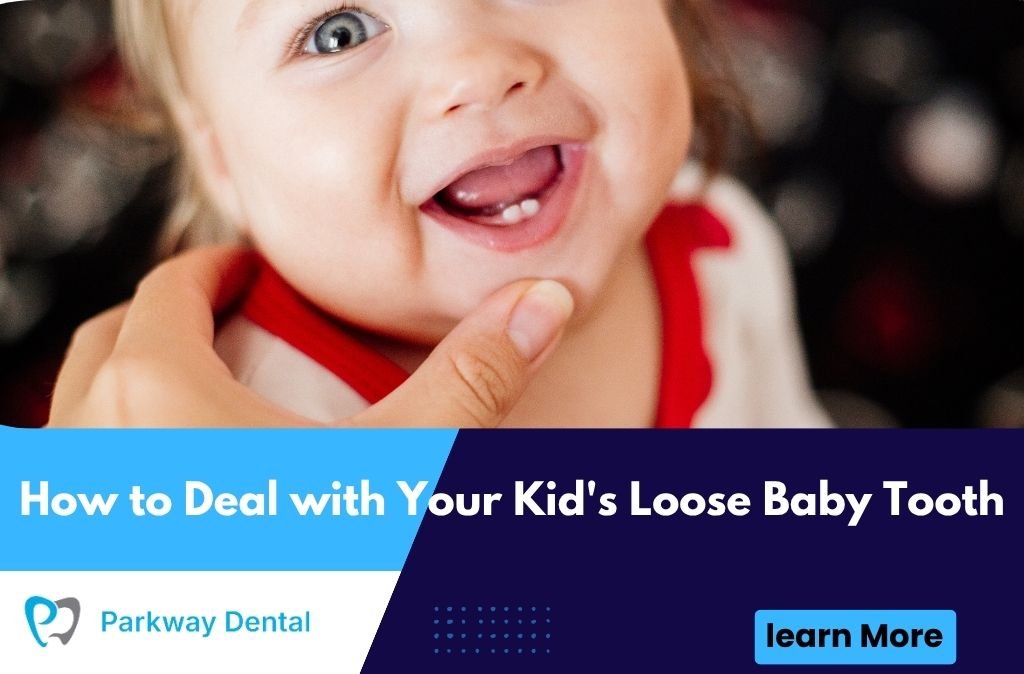
Watching your child lose their first baby tooth is a genuine milestone that marks their transition from early childhood into the school-age years. While this natural process is exciting for both parents and children, it also brings uncertainty and questions about how to handle loose teeth properly. Should you help wiggle it out or let it fall naturally? What if the adult tooth is coming in behind the baby tooth? What does dark gum around a loose tooth mean? How long does a loose tooth usually take to fall out once it starts wiggling?
This guide provides practical, clear answers for managing your child’s loose baby teeth at every stage: what age to expect it, how the process works, when to help and when to wait, how to recognize complications, and when to call a dentist. If you have specific concerns about your child’s tooth development and are in the West Roxbury area, Parkway Dental provides family dental care and can answer questions about your child’s specific situation.
Table of Contents
When Do Kids Lose Baby Teeth? Age and Order Guide
Most children begin losing baby teeth around age 6, though the normal range is quite wide. Some children start as early as age 4 and others do not lose their first tooth until age 7 or 8. Both early and late starts are typically normal. What matters more than a specific age is that teeth are falling out in a generally predictable sequence.
The typical baby tooth loss order:
- Lower central incisors (bottom two front teeth): age 6 to 7, usually the first to go.
- Upper central incisors (top two front teeth): age 6 to 8.
- Lower lateral incisors: age 7 to 8.
- Upper lateral incisors: age 7 to 8.
- First molars: age 9 to 11.
- Lower canines (cuspids): age 9 to 12.
- Upper canines: age 10 to 12.
- Second molars: age 10 to 12.
Most children have lost all 20 baby teeth and replaced them with permanent teeth by around age 12 to 13, with the exception of wisdom teeth which typically erupt in the late teens. Boys and girls follow slightly different timelines on average, with girls often losing teeth a few months earlier.
If your child has not started losing teeth by age 8, or if a tooth that should have fallen out by a specific age is still firmly in place long after neighboring teeth have been lost, consult a dentist. An X-ray can confirm whether permanent teeth are developing normally underneath.
Understanding the Baby Tooth Loss Process
Baby teeth become loose because permanent teeth developing beneath the gums push upward through the bone and gum tissue. As a permanent tooth approaches the surface, it applies pressure to the root of the baby tooth above it. The body responds by gradually resorbing (dissolving) the root of the baby tooth from the tip upward. As the root disappears, the tooth loses its anchor and becomes progressively looser.
By the time a baby tooth is truly ready to come out, most or all of its root has dissolved and only a small amount of soft tissue is still holding it in place. At this stage the tooth falls out with minimal force, minimal bleeding, and minimal discomfort. The dramatic, traumatic tooth pulls you might have seen in old movies are not necessary or appropriate for a tooth that has properly loosened.
Signs of a naturally loosening tooth that is progressing normally include: the tooth wiggles when touched but is not painful, your child can move it with their tongue, the looseness gradually increases over days to weeks, you might notice the permanent tooth beginning to appear behind or just below the gum near the baby tooth, and the gum may be slightly redder or slightly raised around the loose tooth. These are all normal.
How Long Does a Loose Baby Tooth Take to Fall Out?
Once a baby tooth starts visibly wiggling, it can take anywhere from a few days to several weeks to fall out on its own. The timeline varies based on how far along the root resorption is when you first notice the looseness.
Some teeth that are already nearly rootless when a child first notices the wiggling will fall out within 2 to 5 days. Others that still have significant root remaining will wiggle for 3 to 8 weeks before the root is fully resorbed and the tooth drops out. Both timelines are completely normal.
Encouraging gentle daily wiggling by the child (with clean hands or tongue) helps the process along because movement stimulates the resorption process. Crunchy foods like apples and carrots during meals also provide gentle natural pressure.
If a tooth has been significantly loose for more than 2 to 3 months without falling out, a dentist should check whether the root resorption has stalled or whether there is an obstruction preventing normal loss.
When to Let Nature Take Its Course
In the vast majority of cases, the best approach to a loose baby tooth is patience. Waiting for the tooth to fall out on its own timeline offers real advantages over forced removal.
The tooth comes out when it is truly ready, making the experience nearly effortless and pain-free. Waiting ensures the root has fully resorbed, so when the tooth does come out there is minimal bleeding and minimal trauma to surrounding tissue. Your child maintains a sense of control and agency over the process, which significantly reduces anxiety. Natural loss protects the emerging permanent tooth underneath from accidental force or pressure.
Most baby teeth fall out during meals, while brushing, or simply during sleep. Many children barely notice the moment a tooth comes out because by that point it is so loosely attached it requires essentially no force.
When Intervention May Be Necessary
While patience is usually best, certain situations make gentle help appropriate.
Consider assisting with removal if the tooth is so loose it is only held by a visible thread of tissue, if it is causing significant pain when eating or speaking, if the child is very bothered by it and wants it out, or if the tooth has been visibly very loose (hanging by a thread) for more than a week without coming out naturally.
Other situations that warrant a dentist call rather than home removal: the tooth has been significantly loose for 2 or more months without progressing toward falling out, the tooth is loose due to injury rather than natural development, the area looks infected with visible pus, swelling, or fever, or the tooth is extremely loose in a child younger than 4 to 5 years old (premature loss requires professional evaluation).
How to Safely Pull a Loose Baby Tooth at Home
If the tooth is hanging by a thread and your child is ready for it to come out, home removal is straightforward when done carefully.
Have your child wash their hands thoroughly, or wash your own hands if they want your help.
Let your child try first. Many children prefer to wiggle the tooth out themselves using their clean fingers or tongue. This gives them control and typically causes the least discomfort.
If they want your help, grasp the tooth firmly with a clean piece of gauze or tissue for grip. Apply one gentle, quick rotating or rocking motion in the natural direction of the tooth (down and slightly forward for upper teeth, up and slightly forward for lower teeth).
If the tooth does not come out with minimal effort, stop immediately. It is not ready yet. Forcing a tooth that is not fully loosened causes bleeding, pain, and potential damage to surrounding tissue and the erupting permanent tooth.
Once the tooth is out, have your child bite gently on a small folded piece of clean gauze for 5 to 10 minutes to control any minor bleeding.
Never use string tied to a doorknob, dental floss yanked sharply, pliers or household tools, or any technique involving sudden high force. These approaches cause unnecessary trauma. A tooth that truly needs more time will not come out cleanly with force and fragments, roots, or gum tissue injuries can result.
For a full guide to home tooth removal including what is safe for adults versus children, see our blog on how to pull out a tooth safely.
What to Do If the Permanent Tooth Is Coming In Behind the Baby Tooth (Shark Teeth)
One of the most common concerns parents bring to dentists is the discovery that their child’s permanent tooth is erupting behind the baby tooth before the baby tooth has fallen out. Parents sometimes call this “shark teeth” because the double row of teeth resembles a shark’s jaw.
This situation is more common than most parents realize. It occurs most frequently with the lower front teeth and typically resolves on its own without intervention. When the permanent tooth emerges, it does not always push the baby tooth from directly below. Sometimes it comes up slightly behind it. If the baby tooth is already loose when you notice this, continue encouraging your child to wiggle it. In most cases the baby tooth falls out within a few weeks of the permanent tooth becoming visible, and the permanent tooth then migrates forward into its correct position under the pressure of the tongue.
When to call a dentist about shark teeth: if the baby tooth does not feel loose at all when the permanent tooth is already significantly erupted, if the permanent tooth has been visible for more than 2 to 3 months without the baby tooth loosening, or if the permanent tooth appears to be erupting very far out of normal alignment. In these cases, the baby tooth may need professional extraction to prevent the permanent tooth from becoming permanently displaced.
The American Academy of Pediatric Dentistry notes that ectopic eruption (teeth erupting in atypical positions) is one of the most common childhood dental presentations and is very often manageable with watchful waiting.
Why Is My Child’s Loose Tooth or Gum Dark?
A darkened or grayish tooth in a child’s mouth is a question that deserves a direct answer because it understandably worries parents.
If a baby tooth that was previously normal in color has become gray, dark yellow, or dark brown, it most commonly indicates one of the following:
Internal bleeding following a knock or impact. Even a relatively minor bump to the mouth can cause blood vessels inside the tooth to rupture. The blood pigment (hemosiderin) stains the tooth from the inside, causing the gray discoloration. The tooth may be asymptomatic and may still fall out naturally on its normal timeline. However, any tooth discoloration following an impact should be evaluated by a dentist to check for pulp damage.
Pulp death or abscess formation. If a cavity was left untreated and reached the pulp of the tooth, the nerve tissue can die, causing the tooth to darken. An abscess may form at the root tip. This requires dental treatment even in baby teeth because an untreated abscess can damage the developing permanent tooth beneath it.
Dark gum around a loose baby tooth (rather than the tooth itself being dark) can be normal blood pooling in the gum tissue as the root resorbs and the tooth naturally detaches. This typically looks like a bruise-like purplish area on the gum near the tooth and is not a cause for concern unless it is accompanied by pain, swelling, or bad odor.
If you see dark gum around a loose tooth with no other symptoms: monitor it and let the tooth continue loosening naturally. If the dark gum is accompanied by pain when the tooth is touched, visible swelling, fever, or bad taste, contact a dentist. This may indicate infection that requires treatment even in a tooth that is in the process of falling out.
Managing Pain and Discomfort
Loose teeth occasionally cause mild discomfort, but significant pain from a baby tooth that is loosening naturally is uncommon. If your child is in notable pain from a loose tooth, it is worth having a dentist check that the discomfort is from normal loosening rather than an underlying infection or crack.
For mild discomfort, cold foods like popsicles, chilled applesauce, or ice chips numb the area and reduce inflammation. Have your child rinse with warm salt water (one-quarter teaspoon salt in 8 ounces of warm water) to soothe irritated gums. Apply a cold compress wrapped in a cloth to the outside of the cheek for 10-minute intervals if there is swelling.
For more significant discomfort, children’s acetaminophen or ibuprofen at the appropriate weight-based dose provides relief. Ibuprofen is preferable if there is any visible swelling because it addresses inflammation. If pain requires repeated doses of pain medication over more than a day or two, contact your dentist rather than continuing to manage it at home.
Maintaining Oral Hygiene With Loose Teeth
Keeping the mouth clean during the tooth-loss phase prevents gum infection and promotes healthy tissue for the incoming permanent teeth.
Continue brushing twice daily even when a loose tooth is present. Use a soft-bristled toothbrush with gentle circular motions around the loose tooth rather than aggressive scrubbing. Do not skip the area entirely: gentle cleaning prevents bacterial buildup that can cause gum infection. Your child may prefer to brush the loose tooth area themselves for better control.
Floss carefully around adjacent teeth, avoiding forcing floss around the loose tooth itself if it causes pain or excessive movement. Once the tooth falls out, resume gentle flossing in that area after a day or two once initial healing has occurred.
What to Expect After the Tooth Falls Out
After a baby tooth comes out naturally, expect a small amount of bleeding that stops within 5 to 10 minutes of gentle gauze pressure. The empty socket will appear as a small opening in the gum and may look slightly red or puffy for a day or two. Some children experience very minor sensitivity or soreness for 24 to 48 hours.
The permanent tooth may be visible just beneath the gum right away, or it may not emerge for several weeks or even months. Both are normal depending on how far along the permanent tooth’s development was when the baby tooth came out.
Care for the empty socket: have your child rinse gently with water after meals. Continue gentle brushing around the area. Avoid very hard, spicy, or extremely hot foods for the first day if the area feels tender. The socket heals quickly: gum tissue typically closes visibly within a few days to a week.
Recognizing Potential Problems
Most baby tooth loss is completely uneventful. These are the signs that warrant contacting a dentist:
- Bleeding that does not stop after 15 to 20 minutes of firm gauze pressure. Apply steady pressure and do not keep lifting the gauze to check.
- Signs of infection including visible pus at the gumline, increasing swelling after the tooth comes out rather than decreasing, fever, or a bad taste or smell from the socket.
- Significant pain that does not respond to over-the-counter medication after the tooth falls out.
- A tooth that has been visibly loose (not just minimally wiggly) for more than 2 to 3 months without falling out.
- A permanent tooth that has been visibly erupting behind the baby tooth for more than 2 to 3 months without the baby tooth loosening.
Any tooth becoming loose due to injury before the normal tooth loss age of 5 to 6 years. Premature loss from injury can affect spacing and may require a space maintainer.
Creating a Positive Experience
How you approach loose teeth shapes your child’s attitude toward dental care for years.
Turn tooth loss into a celebration. Let your child keep their lost tooth in a special container or tooth fairy pillow. Take photos to document the milestone. Many families keep a simple chart noting which teeth have been lost and when, creating a fun record of this stage.
Reduce anxiety by explaining clearly that losing baby teeth is a normal, necessary part of growing up: their baby teeth are making room for the strong adult teeth that will last their lifetime. Reassure your child that most teeth come out easily when they are ready. Never force removal or pressure an anxious child. Share positive stories from your own childhood and let them talk to older siblings or friends who have already lost teeth.
Maintain a calm, matter-of-fact attitude yourself. Children are perceptive and parents who express visible anxiety about the process pass that anxiety along. If you treat loose tooth loss as the normal, routine milestone it is, your child will too.
Special Situations: Injury, Delayed Loss, and Space Maintainers
Tooth Loss From Injury
If a baby tooth becomes loose due to a fall, sports injury, or impact before your child is in the typical age range for natural tooth loss, seek dental evaluation even if the tooth eventually falls out on its own. An X-ray can confirm whether the injury affected the permanent tooth developing below.
If a baby tooth is knocked out entirely before its normal time, a dentist may recommend a space maintainer to hold the gap open and prevent adjacent teeth from drifting into the space before the permanent tooth is ready to erupt. Space maintainers are simple devices that sit in the gap and prevent shifting. They are removed once the permanent tooth begins erupting.
Delayed Tooth Loss
If your child has not begun losing any teeth by age 8, schedule a dental evaluation. X-rays can confirm whether permanent teeth are developing normally or whether there is a problem such as impacted teeth, abnormal tooth development, or congenitally missing permanent teeth (teeth that simply did not develop, which affects a small percentage of the population). Early identification of these issues allows for better long-term treatment planning.
Retained Baby Teeth
Occasionally a baby tooth remains in place well past when it should have fallen out because no permanent tooth is developing beneath it to push it out. Without the stimulus of an erupting permanent tooth, the baby root does not fully resorb. These retained teeth may stay in place for years. Your dentist monitors them and advises on timing for extraction when appropriate.
The Role of Regular Dental Visits
Professional dental care throughout the tooth-loss years ensures everything progresses normally and identifies any issues early.
Regular checkups every 6 months allow your dentist to monitor tooth loss patterns, evaluate permanent tooth development through X-rays, ensure adequate spacing for emerging teeth, identify potential orthodontic concerns early, and provide guidance specific to your child’s dental development. These preventive visits are especially important during the mixed dentition phase when your child has both baby and permanent teeth simultaneously.
Schedule your child’s routine dental check-up at Parkway Dental. Building a positive relationship with a dentist during the tooth-loss years establishes comfort with professional dental care that benefits your child for life.
Conclusion
Dealing with your child’s loose baby teeth is a natural developmental stage that typically requires minimal intervention beyond patience, good hygiene, gentle monitoring, and a positive attitude. Understanding the normal sequence, knowing when to wait and when to act, and recognizing the signs that need professional attention helps you guide your child through this milestone with confidence.
Every child’s timeline is different. Some children lose their first tooth at 4, others not until 8. Some teeth fall out within days of becoming loose, others wiggle for weeks. Trust the process, encourage gentle daily wiggling, and do not hesitate to call your dentist when something does not feel right.
If you have questions about your child’s tooth development, are concerned about delayed loss, shark teeth, dark discoloration, or an injury, contact Parkway Dental in West Roxbury, MA. Our team provides family dental care and can give your child’s situation a professional evaluation and specific guidance.
Frequently Asked Questions
At what age do kids start losing baby teeth?
Most children begin losing baby teeth around age 6, with the lower front teeth typically going first. The normal range is age 4 to 8 for the first lost tooth. The process continues until around age 12 to 13 when the last baby molars are replaced. Girls often lose teeth slightly earlier than boys on average. If your child has not started losing teeth by age 8, a dental evaluation with X-rays is recommended to confirm normal permanent tooth development.
How long does a loose baby tooth take to fall out?
A loose baby tooth can take anywhere from a few days to several weeks to fall out once it starts wiggling, depending on how far along the root resorption is. A tooth that is already barely attached may fall out within 2 to 5 days. A tooth with significant root remaining may wiggle noticeably for 3 to 8 weeks before the root fully dissolves and the tooth drops out. Encouraging daily gentle wiggling by your child helps move the process along.
Should I pull my child’s loose tooth?
Only if it is hanging by a visible thread of tissue and your child is comfortable with the idea. At that stage, gentle home removal using clean hands and gauze with a simple rotating motion is appropriate and safe. If the tooth requires any significant force to remove, it is not ready and should be left to fall out naturally. Never force a tooth that has noticeable resistance.
What happens if a baby tooth does not fall out on its own?
If a baby tooth remains in place without loosening for an extended period (more than 2 to 3 months of visible looseness, or still present well past the expected age range), a dentist should evaluate it. In some cases the permanent tooth is not developing beneath it, meaning there is no resorption stimulus. In other cases the root resorption process has simply stalled. Your dentist can determine whether the tooth needs professional extraction to make way for the permanent tooth.
What do I do if the permanent tooth is coming in behind the baby tooth?
This is called ectopic eruption or “shark teeth” by parents, and it is very common, especially with lower front teeth. In most cases, if you encourage your child to wiggle the baby tooth daily, it will loosen and fall out within a few weeks, allowing the permanent tooth to migrate forward naturally. Contact a dentist if the baby tooth does not feel loose at all despite the permanent tooth being significantly erupted, or if the situation has persisted for more than 2 to 3 months without the baby tooth loosening.
Why is my child’s loose tooth turning dark or gray?
A darkening baby tooth most commonly indicates internal bleeding following an impact (even a minor bump) or death of the tooth pulp from an untreated cavity. Either situation warrants a dental evaluation because a pulp infection in a baby tooth can damage the permanent tooth developing beneath it. Dark or purplish gum tissue around a loosening tooth (rather than the tooth itself being dark) is often just blood pooling as the root detaches naturally and is less concerning, though it should still be noted to your dentist at the next visit.
Is it safe to pull out a loose baby tooth at home?
Yes, when done correctly for a tooth that is genuinely ready. A tooth that is hanging by a thin thread of tissue can be gently removed at home using clean hands, gauze for grip, and a single gentle rotating motion. If the tooth requires force, stop and wait. Avoid string, door tricks, pliers, or any high-force method. A tooth that needs those approaches is not ready and they cause unnecessary trauma.
What is normal bleeding after a baby tooth falls out?
A small amount of bleeding for a few minutes is completely normal. Have your child bite gently on clean gauze or a damp tea bag for 5 to 10 minutes without peeking. Bleeding that does not stop after 15 to 20 minutes of steady pressure, or that restarts significantly after the first hour, warrants a call to a dentist.
Can a baby tooth fall out too early?
Yes. Baby teeth lost significantly before the normal age range due to decay or injury are called prematurely lost teeth. When a baby tooth is lost early, adjacent teeth can drift into the gap and block space for the permanent tooth that eventually needs to erupt there. A dentist may recommend a space maintainer to preserve the gap until the permanent tooth is ready. If your child loses a tooth before age 5, or from injury rather than natural loosening, schedule a dental evaluation.
What should I do about my child’s loose tooth if they are afraid?
Never force removal on a frightened or unwilling child. A baby tooth that falls out naturally causes minimal discomfort, and patience almost always results in the tooth coming out on its own within weeks. Explain that the tooth is falling out to make room for their grown-up teeth, read books about tooth loss together, let them talk to siblings or friends who have been through it, and maintain a calm matter-of-fact attitude yourself. If anxiety about dental care extends beyond loose teeth, discuss this with your dentist who can provide child-friendly explanations and support.
What if my child swallows their tooth?
Swallowing a baby tooth is harmless. The tooth will pass through the digestive system without any issue. Do not be alarmed if your child reports swallowing their tooth accidentally during a meal or while sleeping.